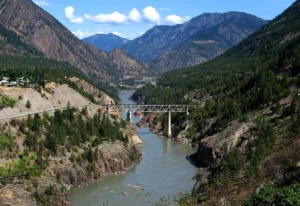
The Fraser River

Written by Jane Carrico

“In this lash and spill of water, in the slow grinding of rock and cliff, in the perpetual slide of mountain and forest, in the erosion of mountain and gumbo rangeland, in the impact of whirlpool and winter ice, the river is forever mad, ravenous and lonely.”

Bruce Hutchinson, The Fraser

In 1670, the British Crown granted Hudson’s Bay Company control over fur trade in the Canadian Shield. To sidestep this monopoly, independent traders in Montreal founded the North West Company a century later. Their mission: to seek fresh territory westward and find a navigable river route from the Rocky Mountains to the Pacific Ocean.

In 1805, Nor’wester Simon Fraser & his crew crossed the Rockies and built four NWC trading posts as far south as Fort George at the confluence of the Nechako River & Tacoutche Tesse – The Mighty One – a river they thought was the Columbia. In the spring of 1808, Fraser set out from here in four canoes with two Scots clerks, two Dakelh First Nation native guides and nineteen French Canadian voyageurs to follow it to its mouth.

The first day was harrowing and difficulties navigating the river only increased. When warned by their guides that the impassable Bridge River Rapids were ahead, they left their canoes at Leon Creek and portaged “on a regular path” through country Fraser called “the most savage that can be imagined” but the Dakelh guides would not enter St’át’imc territory.

The expedition was soon met by seven St’át’imc warriors “in readiness for attack” but they were able to negotiate for provisions including “excellent dried salmon” and wild onion syrup.

Continue ReadingThe Fraser River

East Lillooet Japanese-Canadian World War II Interment Camp Site

Written by Jane Carrico

On December 7, 1941, an event took place that had nothing to do with me or my family and yet which had devastating consequences for all of us – Japan bombed Pearl Harbour in a surprise attack. With that event began one of the shoddiest chapters in the tortuous history of democracy in North America.

Dr. David Suzuki, Metamorphosis: Stages in a Life

When the Second World War extended to the Asia-Pacific regions the Canadian government culminated decades of prejudice against Japanese Canadians by declaring them “enemy aliens” and immediately confiscating their radios, cameras, vehicles and fishing boats. Under the War Measures Act, residents of coastal communities were to be forcibly removed. Men were sent to road construction camps while women, children and elderly were sent to malodorous and unsanitary livestock barns… before being incarcerated in hastily constructed internment camps and abandoned resource towns beyond an imposed 100-mile coastal restricted zone.

Families who were more financially resourceful negotiated to stay together in “self-supporting” camps. The three camps in the Lillooet area – Minto, Bridge River and here in East Lillooet – were all in this category.

Despite inflammatory editorials in the local newspaper opposing their presence, in April of 1942, the first arrivals in East Lillooet constructed sixty-two tarpaper shacks that came to house over three hundred people while their former comfortable homes, possessions and properties were auctioned off.

Continue ReadingEast Lillooet Japanese-Canadian World War II Interment Camp Site