Written by Jane Carrico
“There are all kinds of people on earth that you will meet someday… They will be looking for a certain stone… They will be people who do not get tired but who will keep pushing forward, going, going all the time… They will travel everywhere looking for this stone which our great-grandfather put on the earth in many places.”
Sweet Medicine, Cheyenne Prophet
In 1846, Hudson’s Bay Chief Factor James Douglas sent Alexander C. Anderson to find an all-British route for fur brigades from New Caledonia to the Pacific coast. Anderson explored the series of rivers, lakes and First Nations trails between Harrison Lake and Lillooet but concluded that a short season of unloading & portaging goods made the route as impractical as the Fraser River.
Ten years later, Douglas began supplying First Nations with hand tools to collect placer gold for trade in the Fraser River watershed while American miners trickled in from Oregon Territory. Douglas sent a shipment of gold to the San Francisco mint in 1857, word got out and the stampede was on.
By 1858, there were 30,000 or more miners along the Fraser River and they faced a winter without re-supply.
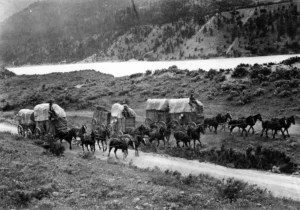
Douglas contracted Otis Parsons to build a pack trail along the route Anderson explored with labour supplied by the miners themselves. Two years later, the Royal Engineers upgraded the trail into a wagon road and three new steamboats were built to operate on the lakes between Harrison Lake and Lillooet.
Lillooet became an important mining centre & transportation hub with a cable ferry across the Fraser operated by Parsons.