Golden Miles of History

  •   Parking: N50° 40’ 97.9’’ W121° 55’ 89.1’
    Park at Bridge of the 23 Camels.
  •   Distance: 4.5 km (2.8 miles)
  •   Time: 1 to 1.5 hours one-way
  •   Difficulty: Easy to moderate walk

This walk highlights the many sights the Lilllooet Historical Society recommends you enjoy in a town whose post-European contact history dates back to the Cariboo Gold Rush. Pick up a “Golden Mile” brochure at the Lillooet Museum and Visitor Info Centre.

Continue ReadingGolden Miles of History

Miyazaki House

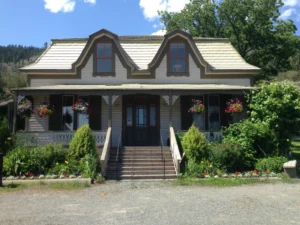
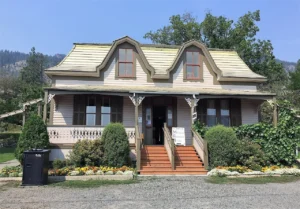
Temporarily closed for renovations that hope to be complete by Spring 2027. The Miyazaki House is a monument for Lillooet and a cultural oasis for all ages while keeping the memory and history of the Phair and Miyazaki families alive. Take a step back in time when you see Doctor Miyazaki’s office just as he left.. The Miyazaki Heritage House and grounds features local music, heritage, and space to rent for private functions.

Continue ReadingMiyazaki House

Miyazaki Heritage House

Written by Jane Carrico

In 1877, Irish immigrant Caspar Phair hiked the Cariboo Road from Yale to accept the position of schoolteacher in Lillooet. The same year, Cerise Armit Eyre graduated from finishing school in England and arrived to join her mother & stepfather on a farm near Pavilion Lake that is still a working cattle ranch today.

Caspar & Cerise were married in 1879 and the following year, the first of their two sons, Arthur William Armit “Artie” Phair, was born. Casper came to hold almost every official position in the area including Government Agent, Gold Commissioner, Magistrate, Chief Constable, Coroner, Fire Chief and Game Warden.

Caspar hired master builder William Duguid to build his family a fine home in the Second Empire Style featuring a mansard roof, bell-cast eaves and four unique mansard-roofed dormer windows. They named their home Longford House. In 1887, Cerise bought a general store on Main Street and the Phairs settled into a prosperous and refined lifestyle in the heart of a wild, frontier town.

By age eighteen, Artie was running the family store but the Phair family fortunes rose and fell with the boom and bust economy of Lillooet.

Caspar & Cerise passed three months apart in 1933. Like his father, Artie came to fill many of the town’s official positions including Coroner but scandalized the townsfolk by letting the manicured gardens of Longford House become overgrown and unkempt while he roamed the rugged mountains surrounding Lillooet taking photographs and collecting butterflies and curios. Without him, much of the area’s history would not have been recorded.

In 1944, Artie was taking pictures in Bridge River when he met Dr. Masajiro Miyazaki who was interned there with his family as the result of WWII policies that removed Japanese Canadians from the west coast. The town was without a doctor at the time so Artie drafted a petition signed by many of the town’s leading citizens that allowed them to move into Lillooet.

Continue ReadingMiyazaki Heritage House

East Lillooet Japanese-Canadian World War II Interment Camp Site

Written by Jane Carrico

On December 7, 1941, an event took place that had nothing to do with me or my family and yet which had devastating consequences for all of us – Japan bombed Pearl Harbour in a surprise attack. With that event began one of the shoddiest chapters in the tortuous history of democracy in North America.

Dr. David Suzuki, Metamorphosis: Stages in a Life

When the Second World War extended to the Asia-Pacific regions the Canadian government culminated decades of prejudice against Japanese Canadians by declaring them “enemy aliens” and immediately confiscating their radios, cameras, vehicles and fishing boats. Under the War Measures Act, residents of coastal communities were to be forcibly removed. Men were sent to road construction camps while women, children and elderly were sent to malodorous and unsanitary livestock barns… before being incarcerated in hastily constructed internment camps and abandoned resource towns beyond an imposed 100-mile coastal restricted zone.

Families who were more financially resourceful negotiated to stay together in “self-supporting” camps. The three camps in the Lillooet area – Minto, Bridge River and here in East Lillooet – were all in this category.

Despite inflammatory editorials in the local newspaper opposing their presence, in April of 1942, the first arrivals in East Lillooet constructed sixty-two tarpaper shacks that came to house over three hundred people while their former comfortable homes, possessions and properties were auctioned off.

Continue ReadingEast Lillooet Japanese-Canadian World War II Interment Camp Site