
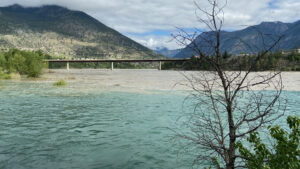
Bridge of the 23 Camels

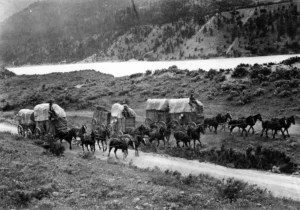
Following the discovery of gold in the Cariboo in 1858 and the completion of the first wagon road to Lillooet, horses, mules and oxen were used to haul heavy loads to the gold fields. An entrepreneur determined that camels would be ideal pack animals, so 23 two humped Bactrian camels were imported from Asia to BC. But this solution became an issue when the high-strung beasts ate miners clothing, kicked at anyone who came close, frightened other animals with their pungent odor, and cut their soft feet on the rocky mountainous roads. The camels were abandoned and left to roam in the wild. Some were killed for food, some died in winter storms, while others were kept as curiosities. The lone surviving Bactrian camel, “The Lady” as she was called, died around 1896 on a farm in Grande Prairie, BC (now known as Westwold).

When the bridge opened in 1981, the name was selected through a contest. Local resident, Renee Chipman submitted the winning name: “Bridge of the 23 Camels” in honour of the camels.

Continue ReadingBridge of the 23 Camels

The Mile “0” Cairn

The Mile ‘0’ Cairn was erected in 1939, marking Mile ‘0’ of the old Cariboo Road. From this point in the early stage coach days, all road houses and stopping places from here to Barkerville were known by their mileage from Lillooet – 70 Mile, 100 Mile, and so on. In 1858, Governor James Douglas ordered the construction of a wagon road from Fort Douglas on Harrison Lake to Lillooet. The Royal Engineers supervised the construction while miners with picks and shovels contracted to build the road for the sum of five English pounds each, which they received upon arrival, by land and portage, at Lillooet. 16,000 gold seekers outfitted here in the next four years, until 1863, when the Fraser Canyon route from Yale finally reached Lytton providing an alternate route.

Continue ReadingThe Mile “0” Cairn

The Goldrush

Written by Jane Carrico

“There are all kinds of people on earth that you will meet someday… They will be looking for a certain stone… They will be people who do not get tired but who will keep pushing forward, going, going all the time… They will travel everywhere looking for this stone which our great-grandfather put on the earth in many places.”

Sweet Medicine, Cheyenne Prophet

In 1846, Hudson’s Bay Chief Factor James Douglas sent Alexander C. Anderson to find an all-British route for fur brigades from New Caledonia to the Pacific coast. Anderson explored the series of rivers, lakes and First Nations trails between Harrison Lake and Lillooet but concluded that a short season of unloading & portaging goods made the route as impractical as the Fraser River.

Ten years later, Douglas began supplying First Nations with hand tools to collect placer gold for trade in the Fraser River watershed while American miners trickled in from Oregon Territory. Douglas sent a shipment of gold to the San Francisco mint in 1857, word got out and the stampede was on.

By 1858, there were 30,000 or more miners along the Fraser River and they faced a winter without re-supply.

Douglas contracted Otis Parsons to build a pack trail along the route Anderson explored with labour supplied by the miners themselves. Two years later, the Royal Engineers upgraded the trail into a wagon road and three new steamboats were built to operate on the lakes between Harrison Lake and Lillooet.

Lillooet became an important mining centre & transportation hub with a cable ferry across the Fraser operated by Parsons.

Continue ReadingThe Goldrush