The Fraser River

Written by Jane Carrico

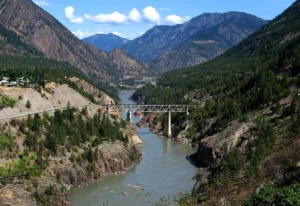
“In this lash and spill of water, in the slow grinding of rock and cliff, in the perpetual slide of mountain and forest, in the erosion of mountain and gumbo rangeland, in the impact of whirlpool and winter ice, the river is forever mad, ravenous and lonely.”

Bruce Hutchinson, The Fraser

In 1670, the British Crown granted Hudson’s Bay Company control over fur trade in the Canadian Shield. To sidestep this monopoly, independent traders in Montreal founded the North West Company a century later. Their mission: to seek fresh territory westward and find a navigable river route from the Rocky Mountains to the Pacific Ocean.

In 1805, Nor’wester Simon Fraser & his crew crossed the Rockies and built four NWC trading posts as far south as Fort George at the confluence of the Nechako River & Tacoutche Tesse – The Mighty One – a river they thought was the Columbia. In the spring of 1808, Fraser set out from here in four canoes with two Scots clerks, two Dakelh First Nation native guides and nineteen French Canadian voyageurs to follow it to its mouth.

The first day was harrowing and difficulties navigating the river only increased. When warned by their guides that the impassable Bridge River Rapids were ahead, they left their canoes at Leon Creek and portaged “on a regular path” through country Fraser called “the most savage that can be imagined” but the Dakelh guides would not enter St’át’imc territory.

The expedition was soon met by seven St’át’imc warriors “in readiness for attack” but they were able to negotiate for provisions including “excellent dried salmon” and wild onion syrup.
Continue ReadingThe Fraser River

The Goldrush

Written by Jane Carrico

“There are all kinds of people on earth that you will meet someday… They will be looking for a certain stone… They will be people who do not get tired but who will keep pushing forward, going, going all the time… They will travel everywhere looking for this stone which our great-grandfather put on the earth in many places.”

Sweet Medicine, Cheyenne Prophet

In 1846, Hudson’s Bay Chief Factor James Douglas sent Alexander C. Anderson to find an all-British route for fur brigades from New Caledonia to the Pacific coast. Anderson explored the series of rivers, lakes and First Nations trails between Harrison Lake and Lillooet but concluded that a short season of unloading & portaging goods made the route as impractical as the Fraser River.

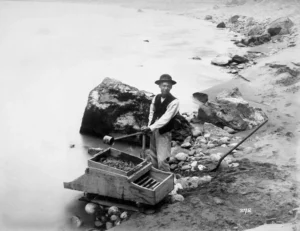
Ten years later, Douglas began supplying First Nations with hand tools to collect placer gold for trade in the Fraser River watershed while American miners trickled in from Oregon Territory. Douglas sent a shipment of gold to the San Francisco mint in 1857, word got out and the stampede was on.

By 1858, there were 30,000 or more miners along the Fraser River and they faced a winter without re-supply.

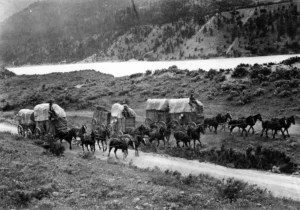
Douglas contracted Otis Parsons to build a pack trail along the route Anderson explored with labour supplied by the miners themselves. Two years later, the Royal Engineers upgraded the trail into a wagon road and three new steamboats were built to operate on the lakes between Harrison Lake and Lillooet.

Lillooet became an important mining centre & transportation hub with a cable ferry across the Fraser operated by Parsons.

Continue ReadingThe Goldrush

The Chinese in Lillooet

Written by Jane Carrico

The Chinese became part of the recorded history of British Columbia during the earliest days of the sea otter trade when they helped independent merchant John Meares build the first trading post on Vancouver Island in 1788. With the market for the valuable pelts in China, British Columbia was part of the Pacific Rim long before it became part of Canada.

Thousands of Chinese nationals flooded into California when gold was discovered there in 1848 but when stringent laws were passed against them many of them headed north to the new Colony of British Columbia where their rights were protected by British colonial law.

As well as being miners, they built roads & wooden flumes, grew vegetables and opened shops, restaurants & laundries. Many were also employed as cooks and housekeepers including by the prominent Phair family here in Lillooet.

Continue ReadingThe Chinese in Lillooet

Japanese Historic Sites in Lillooet

As you journey to Lillooet, you can discover historic sites and learn about the history of Japanese Canadian internment and resilience. One third-generation Japanese Canadian, Laura Saimoto, shared her family’s story of the WWII Internment and Dispossession in the Lillooet area along the Fraser River in this essay.

On Hwy 12 just outside of Lillooet, there is now a memorial to the East Lillooet Internment Camp.

Continue ReadingJapanese Historic Sites in Lillooet

East Lillooet Japanese-Canadian World War II Interment Camp Site

Written by Jane Carrico

On December 7, 1941, an event took place that had nothing to do with me or my family and yet which had devastating consequences for all of us – Japan bombed Pearl Harbour in a surprise attack. With that event began one of the shoddiest chapters in the tortuous history of democracy in North America.

Dr. David Suzuki, Metamorphosis: Stages in a Life

When the Second World War extended to the Asia-Pacific regions the Canadian government culminated decades of prejudice against Japanese Canadians by declaring them “enemy aliens” and immediately confiscating their radios, cameras, vehicles and fishing boats. Under the War Measures Act, residents of coastal communities were to be forcibly removed. Men were sent to road construction camps while women, children and elderly were sent to malodorous and unsanitary livestock barns… before being incarcerated in hastily constructed internment camps and abandoned resource towns beyond an imposed 100-mile coastal restricted zone.

Families who were more financially resourceful negotiated to stay together in “self-supporting” camps. The three camps in the Lillooet area – Minto, Bridge River and here in East Lillooet – were all in this category.

Despite inflammatory editorials in the local newspaper opposing their presence, in April of 1942, the first arrivals in East Lillooet constructed sixty-two tarpaper shacks that came to house over three hundred people while their former comfortable homes, possessions and properties were auctioned off.

Continue ReadingEast Lillooet Japanese-Canadian World War II Interment Camp Site

Vernon Pick & Walden North

Written by Jane Carrico

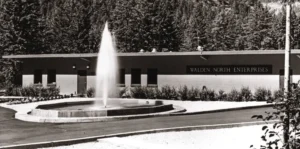
Vernon Pick was one of Lillooet’s most fascinating residents. Born in rural Wisconsin in 1903, he left home at age sixteen and a year later joined the US Marines. After working as a miner in Manitoba, Pick ran an electrical company in Minneapolis for seventeen years before moving back to Wisconsin to build a hydroelectric generator to power a derelict flourmill he converted into an electrical workshop.

Pick had very little formal education – one year of high school and some electrical courses – but he had an appetite for knowledge and spent his spare time studying philosophy, literature, science and religion. He was a multi-talented renaissance man with utopian ideals and a thirst for technological innovation but the quiet, self-sustaining lifestyle Pick and his wife enjoyed in Wisconsin ended in 1951 when a fire destroyed his workshop. The insurance settlement did not cover the cost of its replacement so the Picks decided to buy an Airstream and go west.

They got as far as Grand Junction, Colorado where Pick caught uranium fever. At age forty-eight, he had spent a grueling nine months prospecting in the rugged Utah canyonlands when he made the lucky strike that catapulted him into wealth and fame as the Uranium King of America.

Pick wanted to use his fortune to make a lasting contribution to the future of humanity and converted an estate in California into a research facility staffed with twenty scientists. He renamed it Walden West in honour of his hero, Henry David Thoreau, author of Walden; or Life in the Woods, but his dreams of a nuclear-powered future gradually faded.

In 1965, caught up in the Cold War paranoia and bomb shelter boom of that era, Pick decided to abandon Walden West and build a long-term survival retreat.

Continue ReadingVernon Pick & Walden North