Golden Miles of History

  •   Parking: N50° 40’ 97.9’’ W121° 55’ 89.1’
    Park at Bridge of the 23 Camels.
  •   Distance: 4.5 km (2.8 miles)
  •   Time: 1 to 1.5 hours one-way
  •   Difficulty: Easy to moderate walk

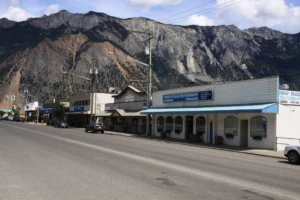
This walk highlights the many sights the Lilllooet Historical Society recommends you enjoy in a town whose post-European contact history dates back to the Cariboo Gold Rush. Pick up a “Golden Mile” brochure at the Lillooet Museum and Visitor Info Centre.

Continue ReadingGolden Miles of History

Jade Walk

  •   Parking: N50° 42’ 21.7’’ W121° 55’ 55.6’’
    Park at Old Mill Plaza.
  •   Distance: 8.7km (5.4 mi)
  •   Time: 2.4 km from mall to cemetery (30-45 minutes), 5.3 km for complete route (1 to 1.5 hours)
  •   Difficulty: Easy to moderate

This trail commemorates Lillooet’s history as the site of the first jade mine in BC. Stroll down Lillooet’s Main Street and enjoy over 30 unique pieces of jade, some weighing many tons. Pick up a brochure at KC Health & Gifts.

Continue ReadingJade Walk

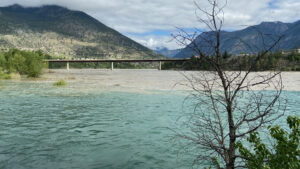
Bridge of the 23 Camels

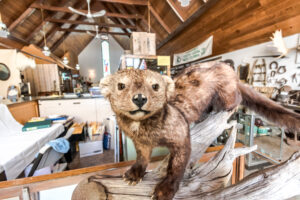
Following the discovery of gold in the Cariboo in 1858 and the completion of the first wagon road to Lillooet, horses, mules and oxen were used to haul heavy loads to the gold fields. An entrepreneur determined that camels would be ideal pack animals, so 23 two humped Bactrian camels were imported from Asia to BC. But this solution became an issue when the high-strung beasts ate miners clothing, kicked at anyone who came close, frightened other animals with their pungent odor, and cut their soft feet on the rocky mountainous roads. The camels were abandoned and left to roam in the wild. Some were killed for food, some died in winter storms, while others were kept as curiosities. The lone surviving Bactrian camel, “The Lady” as she was called, died around 1896 on a farm in Grande Prairie, BC (now known as Westwold).

When the bridge opened in 1981, the name was selected through a contest. Local resident, Renee Chipman submitted the winning name: “Bridge of the 23 Camels” in honour of the camels.

Continue ReadingBridge of the 23 Camels

Hangman’s Tree

This old Ponderosa Pine tree was used as a gallows for the administration of justice more than 100 years ago, when the law in these parts was Sir Matthew Baillie Begbie. The bough that held the noose has since rotted off and the gnarled old pine was cut down but remains on site. There is a record that two thieves were hanged there and buried underneath, but legend has it that in all, eight lawbreakers swung from it. If you don’t think the walk is worthy of the story, it is certainly worthy of the beautiful view.

Continue ReadingHangman’s Tree

Chinese Rock Piles

On both sides of the Fraser River at Lillooet one can find “Chinese Rocks” – a reminder of the search for gold by Chinese people before the turn of the century. Washing the sand and gravel for the elusive yellow metal, the Chinese neatly piled the washed rocks, in some places more than 12 feet high, in long rows. For examples, look close to the Hangmen’s Tree, downstream from the Old Suspension Bridge, and on the east side of the Fraser.

Continue ReadingChinese Rock Piles

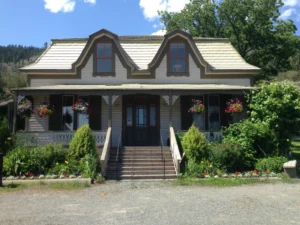
The Old Newspaper Office

The old ‘salt box’ frame house, once ringed with porches, is the former home of the Bridge River – Lillooet News. Established in 1934 by MLA George Murray, the paper was a campaign promise to the Lillooet residents of the day. It was made famous by his wife, Margaret, who gained fame as the inimitable “Ma” Murray. The masthead of her paper proclaimed: “Printed in the sagebrush country of Lillooet every Thursday, God Willing. Guarantees a chuckle every week and a belly laugh once a month or your money back. Subscriptions in Canada. Furriners. Circulation 1573 this week and every bloody one paid for.” The house is now a private residence.

Continue ReadingThe Old Newspaper Office

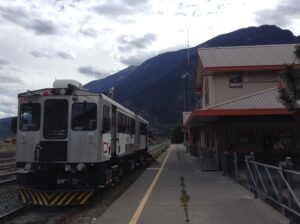
Pacific Great Eastern Railway / BC Rail Station

The old Pacific Great Eastern Railway reached Lillooet in 1914 and continued on into the Interior of BC. Its name was changed to the British Columbia Railway in 1972. The station seen today was built in 1986, replacing the old station that had been constructed in the 1920’s. The original route of the railway was also changed at one point: Originally, the track crossed the Fraser River at Cayoosh Creek, then rerouted through Lillooet to a crossing north of town by the Old Bridge. The old railway bridge was torn down in 1932.

Continue ReadingPacific Great Eastern Railway / BC Rail Station

Jade Trail

British Columbia is the number one source of jade in the world today. The history of jade in Lillooet is from time immemorial.

Jade is part of the geographical history of the region and can still be found on the shores of the local rivers and in the surrounding mountains. Jade is found only in certain unique areas where two rock formations shift, thereby allowing jade to surface from its source fifteen miles deep under the earth’s crust. Lillooet is lucky to be one such rare place.

The local First Nation community used jade as a trade staple – trading north, south, and west within other Indigenous communities. Jade was used to make axes, deer scrapers, tools for daily use, and ceremonial figures.

Continue ReadingJade Trail

Miyazaki House

Temporarily closed for renovations that hope to be complete by Spring 2027. The Miyazaki House is a monument for Lillooet and a cultural oasis for all ages while keeping the memory and history of the Phair and Miyazaki families alive. Take a step back in time when you see Doctor Miyazaki’s office just as he left.. The Miyazaki Heritage House and grounds features local music, heritage, and space to rent for private functions.

Continue ReadingMiyazaki House

The Mile “0” Cairn

The Mile ‘0’ Cairn was erected in 1939, marking Mile ‘0’ of the old Cariboo Road. From this point in the early stage coach days, all road houses and stopping places from here to Barkerville were known by their mileage from Lillooet – 70 Mile, 100 Mile, and so on. In 1858, Governor James Douglas ordered the construction of a wagon road from Fort Douglas on Harrison Lake to Lillooet. The Royal Engineers supervised the construction while miners with picks and shovels contracted to build the road for the sum of five English pounds each, which they received upon arrival, by land and portage, at Lillooet. 16,000 gold seekers outfitted here in the next four years, until 1863, when the Fraser Canyon route from Yale finally reached Lytton providing an alternate route.

Continue ReadingThe Mile “0” Cairn